Friday, 21 April 2017

Review: Travesties

Last night offered an absolute theatrical treat: Tom Stoppard's Travesties, currently showing at the Apollo Theatre, Soho; I enjoyed every minute of it.

Its blurb describes it thus:
Tom Stoppard’s dazzling comedy of art, love and revolution features James Joyce, Tristan Tzara and Lenin as remembered - and misremembered - by Henry Carr, a minor British diplomat in Zurich 1917.
When Gwendolen and Cecily wander in from The Importance of Being Earnest, Henry’s mind wanders too. He knows he was Algernon in a production in Zurich. But who was the other one?
Stoppard's play was written in 1974, but feels like it could have been produced in the last couple of years. Under Patrick Marber's direction, the work is pyrotechnic, with Tom Hollander and Freddie Fox leading a fantastic cast. The two hours thirty fly by as the improbable connections between a series of historical figures are remembered and misremembered by Hollander's character, Carr. The play with language and pace is a joy to witness, and, as has been my experience watching some of Stoppard's other work, when you understand the more intellectual references, you feel properly clever.

It's not all laughs though. The pathos we feel observing Carr's deterioration is real, and Lenin's journey to power holds some uncomfortable resonances for today. There are also some serious arguments made about the nature of art, which do not sound as if they were articulated in the 70s.

Travesties has been pretty much universally well received during this revival, and that must at least partly be due to its freshness and liveliness as a production. Another major draw is its charm. And then there is its well-groomed style. And, of course, the performances. I would struggle to isolate one single thing that made me enjoy this production so much: it's just so good. Everything about it.

If you can catch it before the end of the run, you definitely should.

5/5: Hysterically clever and rightfully proud of it
Apollo Theatre, Soho
Until 29th April

Tuesday, 18 April 2017

Review: Consent

Last night I was fortunate enough to be offered tickets to see Nina Raine's Consent, currently showing at the Dorfman Theatre at the National, so I must start this review with a thank you to the NT's wonderful Secondary and FE Education team.

Of Consent, the NT say:
Why is Justice blind? Is she impartial? Or is she blinkered?
Friends take opposing briefs in a rape case. The key witness is a woman whose life seems a world away from theirs. At home, their own lives begin to unravel as every version of the truth is challenged.
Consent, Nina Raine’s powerful, painful, funny play sifts the evidence from every side and puts justice herself in the dock.
Consent is Nina Raine's fourth play, her previous - Rabbit, Tribes, and Tiger Country - all having been well received. Her latest work, which takes a rape case as a starting point for an exploration of the relationships between a ground of friends, is no exception to her run of great writing.

The use of the rape case, and the persuasive strategies of lawyers, as a framing device takes the notion of manipulating the feelings of a jury, then replays the process through manipulating the audience into feeling sympathy and then loathing for each of the characters in turn whilst they toy with one another's' emotions. Raine's writing is excellent in this respect as she is able to contrast the reductionist guilty/not guilty dualism of the courtroom, with the complexities of real life situations: in Consent, no one is innocent, but everyone deserves sympathy.

The dialogue is phenomenally well written, and the humour is sharp, relatable, and, occasionally, very dark. The performances of the cast of seven - Priyanga Burford, Pip Carter, Ben Chaplin, Heather Craney, Daisy Haggard, Adam James, and Anna Maxwell Martin - are solid, and you really do find yourself sympathising with, then hating different characters as the scenes progress.

The set design is neat but sparse, yet does a surprisingly good job of communicating the world in which the characters live. The sound design is less successful, as some of the transitions feel a bit jarring.

My main issue with the play, however, is the fact that the pacing dips in places, and some of the scene changes are a little awkward, but these are hopefully things which will be ironed out as the run goes on.

I would definitely recommend Consent to you, even if the white, privileged, middle-class world isn't something you find you can relate to, as the play is an absolute masterclass in character development and the writing of dialogue. I found myself applauding Raine as much as the actors on the stage.

4/5: Funny but complex: laugh out loud, then go away thinking
The Dorfman Theatre @ The National Theatre
Until 17th May

Review: Eduardo Paolozzi

A retrospective of Eduardo Paolozzi's work is currently on show at East London's Whitechapel Gallery. Before visiting the exhibition, I didn't think I knew who Paolozzi was, but it turns out that I see his work on a near-weekly basis at both the British Library, and at Tottenham Court Road tube station. The Whitechapel Gallery introduce the exhibition like so:
Eduardo Paolozzi (1924-2005) was one of the most innovative and irreverent artists of the 20th century. Considered the ‘godfather of Pop Art’, his collages, sculptures and prints challenged artistic convention, from the 1950s through to the Swinging Sixties and advent of ‘Cool Britannia’ in the 1990s.
This major Eduardo Paolozzi retrospective spans five decades and features over 250 works; from the artist’s post-War bronzes, revolutionary screen-prints and collages, to his bold textiles and fashion designs.
Alongside Paolozzi’s early brutalist concrete sculptures, highlights include material from his groundbreaking performance lecture Bunk! (1952), his large-scale Whitworth Tapestry (1967) and the iconic sculpture Diana as an Engine (1963).
I wasn't really captured by images used on the promotional material, but on entering the first room of the exhibition my heart lifted at the colour and variety of the work on show. The combination of sculpture, print, and tapestry gave the show a texture very few artists could realistically offer.

The exhibition moves chronologically through Paolozzi's work, but each of the rooms still contains a mixture of prints, textile work, and sculpture. Highlights for me include some of the later figurative sculpture, and the prints that arose from Paolozzi's friendship with the writer J.G. Ballard.
Other significant moments are offered by the huge Whitworth Tapestry, with its bold colours and presence of Mickey Mouse, and the materials from Paolozzi's 1952 'Bunk!' lecture at the ICA.

Paolozzi's magpie-like adoption of different media makes for a kaleidoscopic, and rather marvellous, experience. It is well worth your time to familiarise yourself with an artist whose work is so present in London, yet whose name is still broadly unknown.

Recommended.

4/5: A colourful, lively retrospective from one of art's polymaths.
Whitechapel Gallery
Until 14 May 2017

Tuesday, 4 April 2017

Review: Behind the Mask, Another Mask

Behind the Mask, Another Mask is one of the current exhibitions at the National Portrait Gallery. It is being advertised with a couple of beguiling, surreal images, that don't necessarily make the nature of the show clear. So what is it?
“Under this mask, another mask. I will never finish removing all these faces.” Claude Cahun, 1930
This exhibition brings together for the first time the work of French artist Claude Cahun and British contemporary artist Gillian Wearing. Although they were born almost seventy years apart and came from different backgrounds, remarkable parallels can be drawn between the two artists. Both of them share a fascination with the self-portrait and use the self-image, through the medium of photography, to explore themes around identity and gender, which is often played out through masquerade and performance.
My first response to the exhibition's entry point was one of a casual interest. There were photographs, they were pleasing, but they didn't really set my world aflame. Some casual links between Wearing and Cahun are suggested, but the connections are quite superficial.
Then it gets weird.
 As the exhibition progresses, we see more of Wearing's mask work, and what she has done seems to sit firmly in 'uncanny valley' territory. When you realise that you aren't looking at straight portraits, but recreations of portraits achieved by Wearing in a mask, the effect is unsettling to say the least. The same eyes stare out from faces of different ages and genders in a manner that made me feel really quite uncomfortable. The juxtaposition with Cahun's work then becomes interesting, as there is a strong dialogue between the politics of identity and the fluidity of self-representation. However, the more showy images of Wearing's are staged in a way that almost overshadows Cahun's work, which is actually the more thought-provoking of the two.
The points of intersection between the two artists could bear more development as there are clear similarities and ideological links. As things stand, though, the two artists' images sit alongside one another, talking to each other too infrequently.

Behind the Mask, Another Mask is worth a visit for thinking through the points Wearing and Cahun are making about identity, but it is a far from perfect exhibition. What makes it frustrating is that it could have been a great show. Instead, it's merely a good one.

3/5: Uncanny but undeveloped
National Portrait Gallery
Until 29th May 2017

Thursday, 23 March 2017

Speechlessness in Three Artworks

Speechless, adjective
unable to speak, especially as the temporary result of shock or strong emotion
I am faithless, but sometimes, when confronting an artwork, I feel as if I'm in church.
On, sadly, rare occasions I enter a gallery and experience a moment of stillness so pure it feels transcendental: my heart races, my head spins, I stop breathing for a moment - speechlessness descends as a gift to someone whose life contains little quiet.

It would be nice to think that we all find moments like this in our lives: times where we connect with something greater and more beautiful than ourselves. Times of quiet. But I am not the only person who has to struggle to escape everyday noise.

At different stages in my life, the following three artworks have rendered me speechless, all for different reasons. The were quiet points, where I had the space to think.

1. Turner's Seascapes:

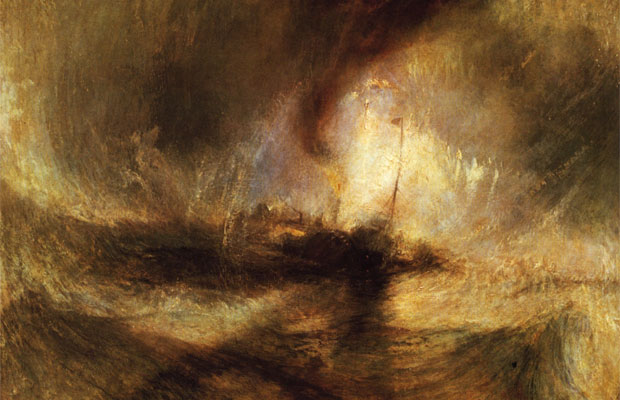
There are examples of Turner's works all over the place in London, but I first fell in love with his seascapes through the 'Turner and the Sea' exhibition at the National Maritime Museum a few years ago. The scale of his late seascapes, stripped of all unnecessary detail, was immense: I felt as if I could be washed away. Turner's courage to pull back details means that you end up with huge, almost abstract canvases, and being surrounded by them is very tranquil.

2. Van Gogh's 'Wheat field with Crows':

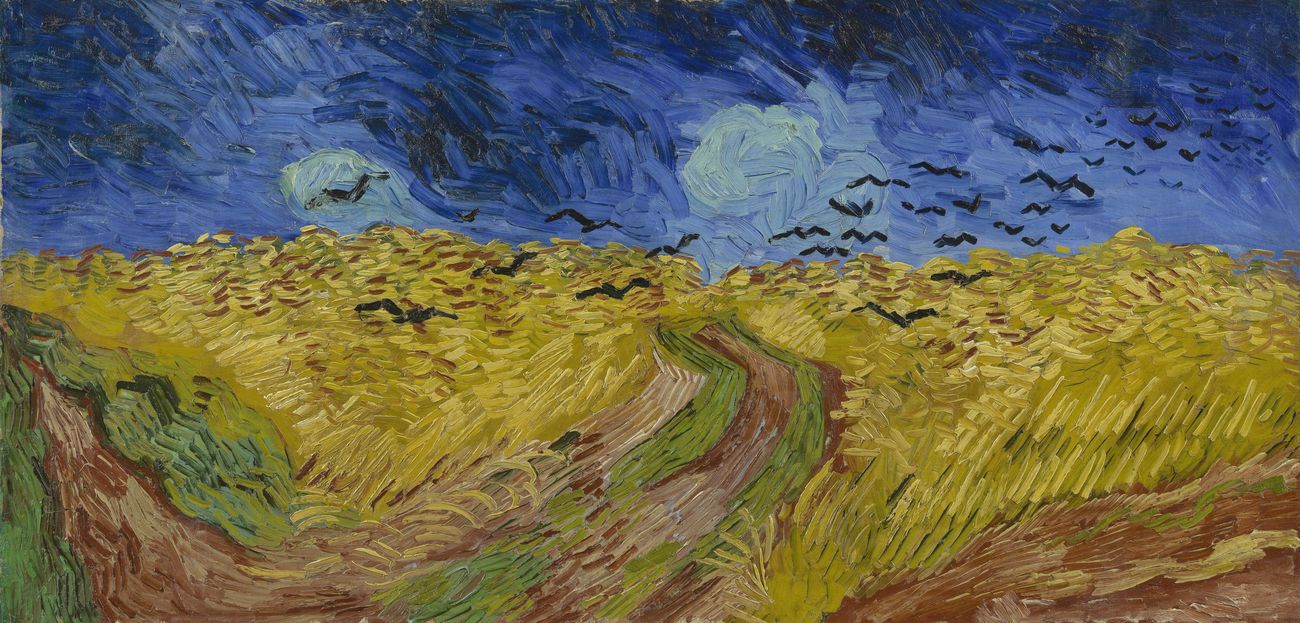
I don't remember when it was I fell for Van Gogh's work, but when I had a brief stopover in Amsterdam for a wedding, I took great delight in going to the Van Gogh museum. The highlight for me was 'Wheat field with Crows', which is a huge canvas that seems to perfectly capture a ripple of disturbance in a field, causing the birds to rise and fly off. I stood staring at the tiny brush strokes, following the movement, until my partner hurried me along. My mind stayed with the painting.

3. Rothko's Seagram Murals:

 My love for Rothko was late in developing. When I studied art at college, I was one of those foolish, pretentious teenagers who thought they had the learning to dismiss abstract expressionism out of hand. Many years, and much maturing, later, and sitting in the room containing the Seagram Murals at the Tate Modern is about as close as I am able to get to a religious experience. You sit in the darkened space and are absolutely surrounded by these massive, abstract canvases. It's well worth waiting for a quiet moment to get in there and claim bench space. It makes me feel small, yet incredibly safe.

What artworks have given you pause? Which artists?

It seems like I don't just look for a single thing in an artwork. It is more a feeling of scale. What I'm looking for, maybe, is something with the scope to put my own life in perspective. Whatever the feeling, it's beyond words.

Saturday, 11 March 2017

Review: Blasted

Styx Theatre is a small North London venue, new to me, and, it turns out, a cool and quirky little space. They are currently running a 90s Season, so I finally had the opportunity to see Sarah Kane's Blasted on stage.

Blasted originally opened at the Royal Court Theatre in 1995, directed by James Macdonald. The story plays out in a room in a hotel in Leeds where Ian, a racist, misogynistic journalist, first attempts to seduce, and then later rapes, Cate, a young woman. The fairly naturalistic opening quickly gives way to a representation of a city at war, where a soldier appears in the room and describes the terrible things he has witnessed and done. The final section deals in scenes of rape, cannibalism, and other forms of savagery. All told, the play is brutal.
The version playing at Styx is stripped down, and some interesting directorial choices give rise to a lot of questions about what is stageable, what is acceptable, and what you can pare away from Kane's work without it losing its impact. The end result is a fantastic rendering of Kane's earliest play, and some of the non-naturalistic choices actually heighten the wrongness of the work, rather than shy away from it.
The stage is black, with minimal setting and use of props. For some of the earlier graphic scenes, the stage directions describing the action are projected on the wall instead of the actors performing the acts themselves. At first I wasn't sure if this was an act of cowardice, but as the play gets more graphic, and moments like Ian's rape are staged, what we actually see realised is a series of contrasts and disquieting tensions. Everything is unnatural, yet plausible in the context of war: you might be disgusted by the soldier, but his story is not necessarily surprising.
The themes of conflict and the extremities of violence have taken on a new significance in this era of war and human displacement. As a consequence, Blasted seems to act as a warning of what happens when humanity is stripped away: it is sadly a play of startling relevance for our contemporary moment.

Recommended, though not if you are easily offended.

4/5: Still shocking, still painful, still human
Styx Theatre
Until 11th March

Wednesday, 8 March 2017

Review: Ugly Lies the Bone

Written by Lindsey Ferrentino and directed by Indhu Rubasingham, Ugly Lies the Bone is currently running on the Lyttelton stage of the National Theatre. They say:
After three tours in Afghanistan, Jess finally returns to Florida. In a small town on the Space Coast, as the final shuttle is about to launch, Jess must confront her scars – and a home that may have changed even more than her.
Experimenting with a pioneering virtual reality therapy, she builds a breathtaking new world where she can escape her pain. There, she begins to restore her relationships, her life and, slowly, herself.
 Now, there are a lot of interesting ideas at work in the play, but overall, nothing is satisfactorily developed. The dramatic use of video projection could have been a powerful way of expressing the virtual world being trialled by Jess (Kate Fleetwood), but some of the design work incorporated by it is, frankly, a bit naff. Meanwhile, the sliding, minimalist set worked quite well, but was nothing revolutionary. 
Acting-wise, Fleetwood is good, and Ralph Little and Kris Marshall's characters are well performed and pleasingly developed, however, the introduction of Jess's mother towards the end of the play is at best trite, and at worst downright tacky.

I think, more than anything, I was frustrated with Ugly Lies the Bone. It had the potential to be exciting and original, it just doesn't quite make it. It's not dreadful, but it is too much of a near miss for me.

3/5: Interesting ideas, average execution
Lyttelton Theatre:
National Theatre.
London
Until 6th June